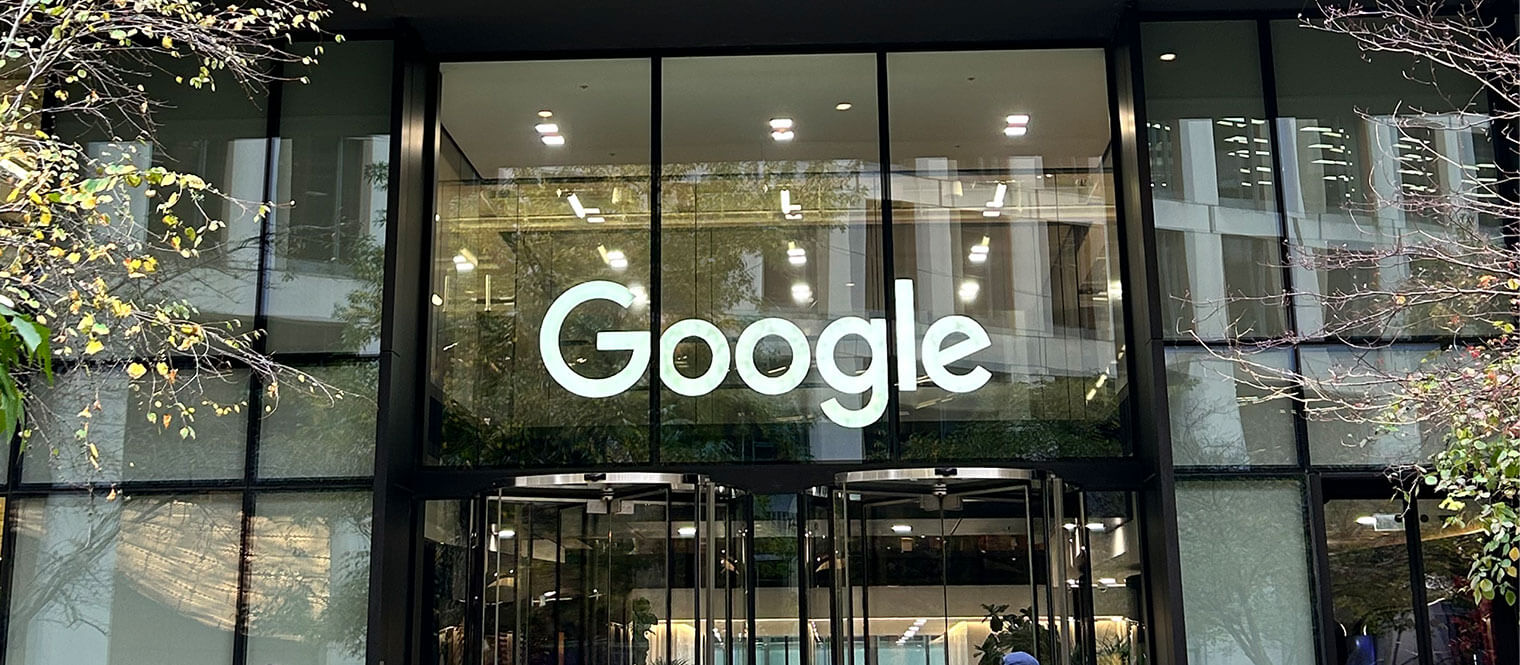
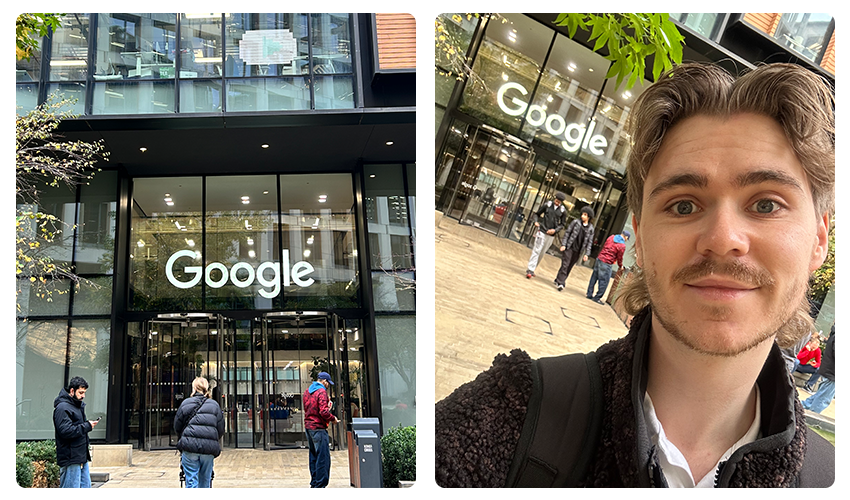
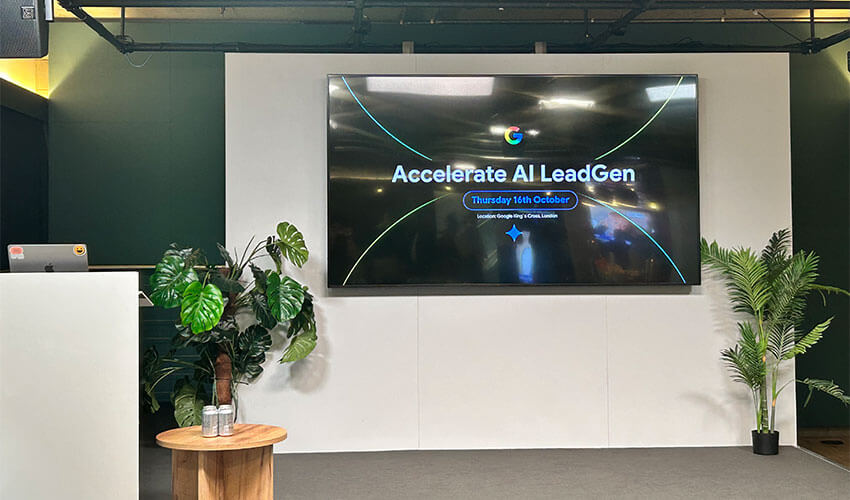
Recently, Chris Hancock, Strategic Partnerships Executive, attended Google’s exclusive “Accelerate AI Leadgen” event at their London office. In this article, Chris details his experience and unique takeaways from the event.
As someone who’s spent years working across PPC and digital strategy, I’ve grown used to the constant culture of change by Google with their ad product development. But this event felt different. It was not focused purely on keyword best practices or recommending that you turn on all auto-recommendations that end up wasting lots of budget. The excitement, the scale, and the pace of what Google presented made one thing clear: we’re entering a new era where the long-standing principles of market-leading creativity, campaign strategy, and data collection need to now work together with AI seamlessly.
The day came with a very clear message: the way we generate leads is changing faster than ever. AI is no longer just a funny image or text writing side too; it’s becoming the foundation of any Google PPC strategy.
Below, I’ve pulled together the key takeaways and reflections from the day, and what they mean for how we approach lead generation moving forward.
Rethinking the foundation: AI as the core of growth, not just a tool
One of the first points Google made was that AI shouldn’t be viewed as a standalone strategy. You shouldn’t be asking “what’s our AI strategy?” but rather “what’s our growth strategy and how can AI enable it?”
That shift in mindset might sound small, but it changes everything. Instead of bolting AI onto existing campaigns, the focus should be on how it can redefine the way marketers plan, execute, and optimise growth through PPC. It’s no longer about efficiency or automation for its own sake; it’s about unlocking scale and insight that would be practically impossible to achieve manually.
Paul O’Hare, Senior Market Lead, reiterated Google’s overall view, which described AI as “the most profound technology ever invented by humans”, and while that might sound grand, the examples they showcased backed it up. From dynamic media creation to AI-powered campaign optimisation, the message was clear: every part of the funnel, from awareness to conversion, is being reshaped by artificial intelligence.
A new kind of search behaviour
One of the most striking insights from the event was how much search behaviour is evolving. Google shared that around 15% of daily searches are brand new, meaning they’ve never been seen before. That’s an astonishing number, and it highlights how fast human behaviour and language are changing in digital environments.
AI is playing a huge role here. Longer, more conversational queries are growing 1.5 times faster than short ones, and Google’s own platforms are changing to reflect this. Features like AI Overviews and AI Mode represent a complete reimagining of search that is moving away from simple queries toward natural, conversational exploration.
This is where tools like Gemini and the upcoming Project Astra come into play. Project Astra, described as part of the “Agentic Era” of AI, is Google’s vision for truly agentive systems; intelligent assistants capable of understanding context, interpreting visuals, and interacting dynamically (imagine something closer to J.A.R.V.I.S. than ChatGPT). It’s early days, but the demonstration they gave was remarkable: a seamless, multimodal agent that could interpret its surroundings, hold a conversation, and act on user intent in real time.
For marketers, this means that search is no longer just a list of results; it’s becoming a dynamic, AI-curated conversation between user intent and contextual insight. Queries are no longer commands; they’re conversations.
From keywords to themes: the end of rigid targeting
In line with this shift, Google encouraged advertisers to start thinking beyond traditional keyword targeting. The future of paid search, they said, lies in themes; broader, intent-based categories that capture relevance more flexibly.
It’s a subtle but important change. Rather than obsessing over exact-match phrases, we’ll increasingly rely on AI-driven intent signals, allowing campaigns to match to billions of different combinations of search intent. This means allowing the AI to do the heavy lifting while we focus on the strategic direction, audience understanding, and creative messaging. As marketers, this is where a real concern has arisen. Fewer levels to pull on the platform must mean less control in optimising performance for clients.
Whilst this sadly does seem to be the case, the human role isn’t disappearing - it’s evolving. Instead of manual optimisation, our value shifts toward data integrity, creative strategy, and interpretation. We become the quality control for the AI tools, ensuring it’s optimising in a way that aligns with business goals, not just algorithmic efficiency.
The role of generative AI in creative and content
Another fascinating theme was how AI is transforming creative production. Google showcased its advancements in generative media, including the new Imagen 4 and Video 3 technologies. These systems allow for photorealistic, physics-based video generation, inpainting (editing elements out of video), and even the reformatting of ads automatically for different placements.
The implications for performance marketing are significant. We’re moving toward a world where professional-level creatives can be built by all. Huge marketing budgets won’t need to be wasted in order to get a b-roll drone shoot of a remote mountainscape; AI can generate this video in no time at all, at a professional and photorealistic standard.
Google also demonstrated how tools like AI Creative Studio and Asset Studio can produce assets directly within the ad platform, meaning marketers will be able to generate tailored imagery and messaging instantly. For those of us managing multiple clients and verticals, this could fundamentally change how we build campaigns by dramatically cutting production time while increasing personalisation and testing opportunities.
The challenge will be balance. As I see it, the temptation to let AI do “everything” creatively will be strong, but grounded human and marketing judgment still matters. The best results will come from AI-augmented creativity, not AI-generated noise.
Smarter campaigns: Demand Gen, Performance Max and the rise of AI Max
Of course, a Google Ads event would be amiss without an entire 2-hour segment covering how Google’s campaign products are evolving to take advantage of these AI capabilities. There is still a large focus on shifting away from a search-only strategy, and implementing the “Powerpack”; an upgrade of the previous “Powerpair” of Performance Max and Demand Gen to include their newest little brother, AI Max.
Demand Gen
Demand Gen campaigns have been improving rapidly, with over 60 updates in the past year alone. They’re designed to reach users across YouTube, Gmail, and Discovery feeds with visual, intent-driven creative perfect for driving awareness and consideration in the earlier stages of the funnel.
Google shared data showing a 26% increase in conversions per dollar for advertisers using Demand Gen compared to similar social campaigns. What makes them powerful is how they tap into Google’s vast behavioural signals to find people who are most likely to convert, even before they search.
Performance Max
Performance Max also continues to evolve. With over 90 improvements in the last year, it remains Google’s flagship AI-powered campaign type. The Channel Performance Report, which provides transparency into where ads appear, is due for full rollout soon. Providing a detailed breakdown of spend and performance channel, finally, is an important step toward giving advertisers slightly more clarity and control that has been asked for for a long time.
Performance Max now also integrates features like URL replacement, text customisation, and search term matching. Together, these functions allow the system to pick the best landing page, tailor copy to user intent, and capture demand that traditional keyword targeting might miss.
AI Max
Google also further introduced AI Max, their latest tool designed to push the boundaries of automation even further. Whilst an additional toggle to all search campaigns rather than an entirely new campaign type, this format uses billions of real-time intent signals to optimise ad placement, copy, and landing pages for your search campaign with minimal human intervention. Early testing showed up to 27% more conversions at a similar CPA or ROAS.
Emphasis was given on giving advertisers the right controls from the start. Brand, targeting, and creative safeguards are built in, ensuring automation enhances your search strategy rather than replacing it.
First-party data: the fuel for AI optimisation
If AI is the latest V-16 engine, first-party data is the fuel. This was one of Google’s central messages throughout the day. With privacy regulations tightening and third-party cookies on their way out, marketers who rely on external data sources are facing diminishing returns.
Instead, the focus needs to shift toward owning, structuring, and activating first-party data. This means a clear focus on building reliable pipelines between CRM systems, analytics platforms, and ad accounts.
Google introduced the concept of Google Tag Gateway, which allows data to be sent directly from a business’s own servers, maintaining it as first-party. Early adopters, Google said, have seen up to a 14% lift in conversions simply by improving data ownership and consistency. The fact that this tool costs nothing to implement except setup time makes it an obvious priority for any business serious about future-proofing its measurement strategy.
Alongside this, Google reiterated the importance of Enhanced Conversions for Leads, which securely passes hashed offline data back to Google for matching against campaign signals. For lead generation marketers, this closes the loop between marketing and sales, ensuring the AI can learn which leads actually convert to revenue.
It’s worth repeating the line they used on stage: “Garbage in equals garbage out.” If your input data is poor, AI will only amplify that weakness. So, as exciting as these huge leaping advancements in automation are, they still depend entirely on the quality of the data you give them.
Measurement and incrementality: understanding true impact
In a rapidly more AI-driven search landscape, it’s becoming even more critical to get your data measurement right.
Google reminded everyone that the days of 100% data collection are gone for good. Between increasing regulations like GDPR and the technical realities of 3rd party cookie depreciation, it’s no longer possible to track every user action. Instead, the focus must shift toward data modelling and incrementality testing.
Two tools in particular stood out:
- Google Tag Gateway enables first-party data flow directly from your business server to Google, preserving ownership and accuracy.
- Meridian, Google’s new marketing mix modelling (MMM) tool, uses advanced regression analysis to map the impact of both online and offline channels. It gives marketers a more complete picture of what’s actually driving performance.
The event also reinforced the importance of incrementality experiments. These are controlled tests that measure the causal impact of a campaign or account change rather than just correlation. This is the only effective way in which we can confidently prove value and make smarter investment decisions.
For agencies like ours, this is the next frontier (pardon the pun). Reporting dashboards that only show click-through rates or cost per lead are no longer enough. We need to integrate incremental lift, lead quality, and pipeline contribution into our success metrics. That’s how we align marketing performance with business growth.
The new role of the marketer: human in the loop
One of the more philosophical points that resonated with me was how the marketer’s role is evolving. In this new landscape, our job is no longer to manually tweak bids or obsess over keywords. Instead, our responsibility is to set the strategy, ensure the data is clean, and interpret the outcomes with human intelligence.
In short, AI doesn’t replace us but does free us to focus on higher-value thinking. I’ve often felt that in a growing AI world, differences in success will be down to those who can shift their prowess into becoming “prompt engineers” rather than traditionalists. Understanding how to best utilise and capture the power of AI tools to drive real business impact is what will make brands of tomorrow stand out.
It demands a new kind of marketer: someone who understands both creativity and data, someone who can brief AI systems effectively and judge when to trust them. The term “AI-literate marketer” came up several times, and it’s one I expect we’ll hear a lot more of in the coming year.
My key takeaways
Reflecting on the day, here’s what stood out most:
- AI is not the strategy - it’s the enabler. Growth remains the goal; AI is just the newest mechanism that gets us there faster and smarter.
- Data integrity is everything. Without clean, structured, first-party data, no amount of AI will fix bad measurement.
- Lead quality trumps lead quantity. The future of lead generation lies in predictive quality scoring, hyper-personalisation, and closed-loop reporting.
- Measurement needs to evolve. Incrementality and modelling are now essential to understand true performance.
- Human creativity remains irreplaceable. The best campaigns will blend human insight with AI capability, not rely on automation alone.
Looking ahead
As I left Google’s office that afternoon, I felt both inspired and awed. The speed at which AI is reshaping marketing is breathtaking, and it’s easy to feel like we’re all sprinting to keep up. But the opportunity available is enormous.
If we as marketers can get it right - combining human creativity and intelligent automation - AI won’t just make our work faster or more efficient. It will make it smarter, more targeted, and ultimately more human.
If you would like to discuss how the evolving AI environment will impact your business, please get in touch with our experts now.
Sources
Google (2025):
- Paul O’Hare - Senior Marketing Lead UKI Google
- Pedro Oliani - Regional Product Lead AI Solutions
- Abdur Rhaman - Product Lead Media Effectiveness