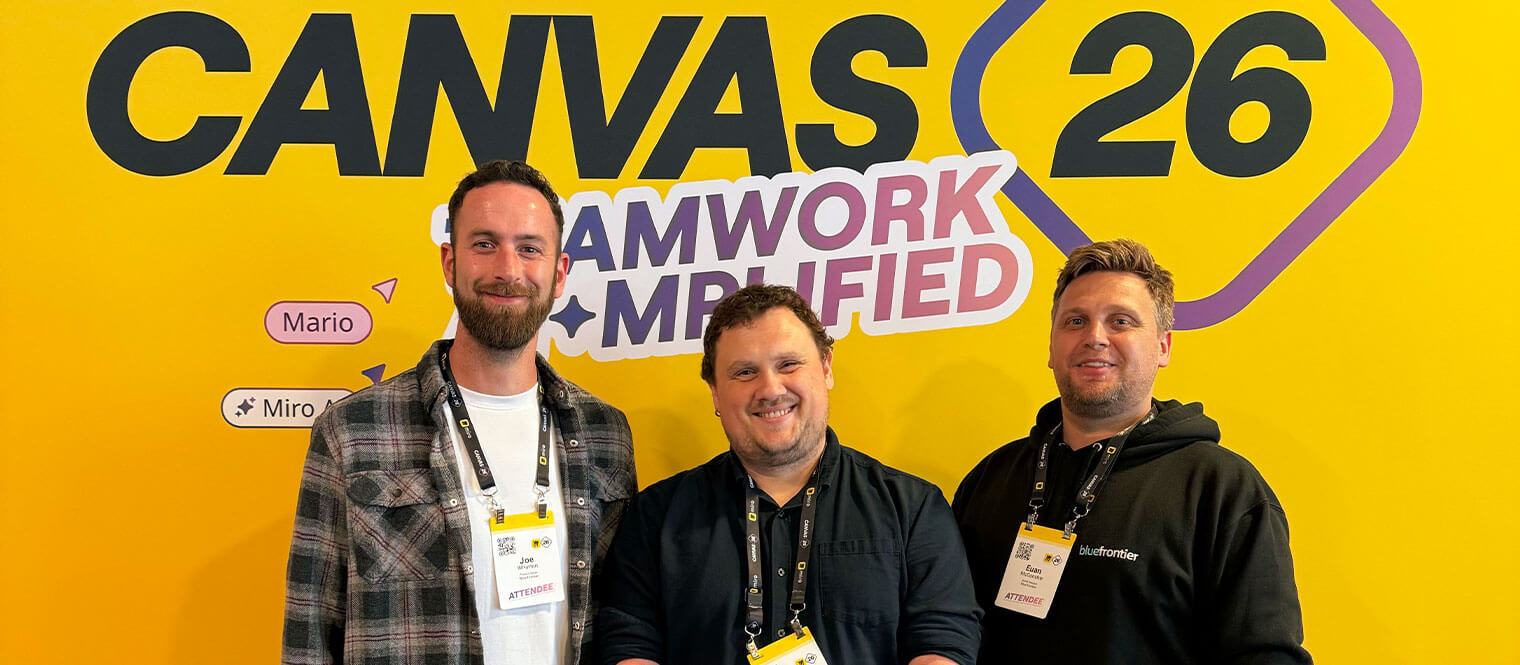
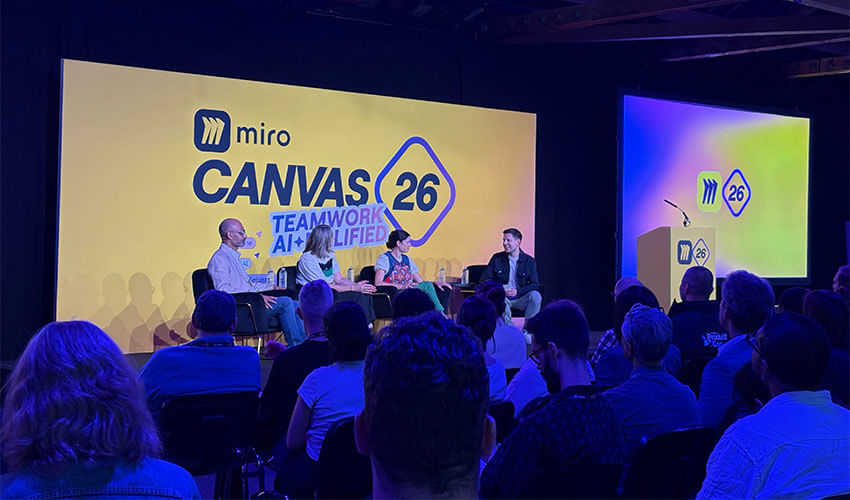
In June, Joe Wharton, Product Owner, Mike Meany, Technical Product Owner, and Euan McConchie, Senior Digital Designer, attended Miro Canvas 26 in London, Miro's flagship event exploring the future of artificial intelligence, collaboration, and design.
AI is transforming the way organisations work. Teams can now create content, build prototypes, and automate repetitive tasks faster than before. But as companies accelerate AI adoption, many are encountering an unexpected stumbling block: while people are more productive, organisations are not always more connected.
That challenge became a defining theme of Miro Canvas 26. Instead of individual productivity, Miro presented a vision of empowering entire organisations to collaborate through a shared AI-powered workspace where people, AI agents, and business systems work together from a single source of truth.
Throughout the event, product demonstrations, customer stories, and leadership discussions all pointed towards the same conclusion: the future of work isn't about individuals moving faster. It's about helping organisations move faster together.
AI is solving one problem while creating another
One of the most thought-provoking discussions centred around how businesses are currently adopting AI.
Most AI tools are designed to improve individual productivity. Employees can create presentations, analyse data, generate documentation, and write code more efficiently than ever before. While this undoubtedly saves time, it can also introduce new silos, with teams relying on different AI tools, prompts, and workflows that disconnect information across an organisation.
From our perspective, this reflects a challenge many businesses are already facing. AI adoption is often happening organically across departments, but without a shared way of working, valuable context can quickly become fragmented.
Miro's response is to make the workspace itself the centre of collaboration, bringing together people, AI, and business information within a single environment. Rather than AI supporting individuals in isolation, the platform is designed to support entire teams working towards the same goals.
Reflecting on Miro's vision of AI supporting entire teams rather than individuals, Euan McConchie said:
Miro highlighted the need to shift from using AI individually to collective team thinking. The real value of AI isn't just making individuals more productive; it's in creating shared understanding, aligned decision-making, and enabling companies to move as one.
This idea underpinned almost every product announcement, with Miro focusing less on individual AI capabilities and more on how teams can collaborate from a shared source of truth.
One idea that stood out throughout the day was the ambition to shift organisations from spending 80% of their time doing and 20% thinking, towards 80% thinking and 20% doing, allowing AI to handle routine execution while people focus on strategy, creativity, and decision-making.
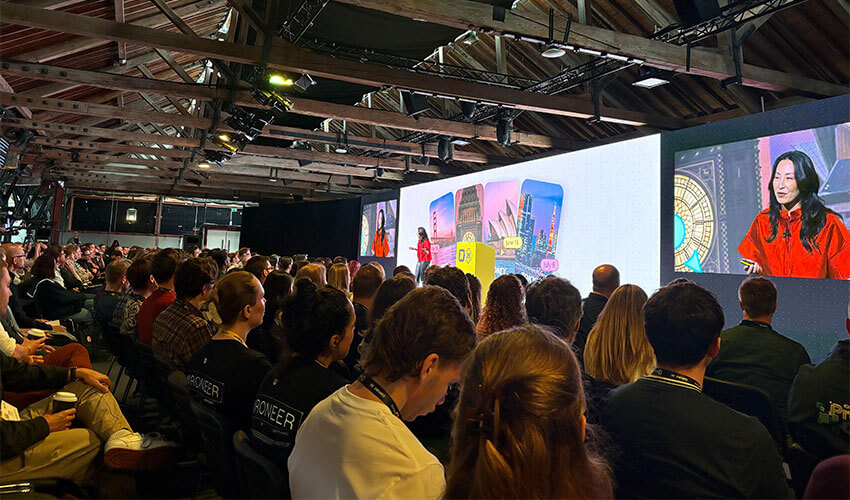
Collaboration is entering a new era
Another memorable insight came from Miro's view of how collaboration is evolving.
The company described three emerging modes of collaboration:
- Human to human
- Human to AI
- AI to AI
Rather than replacing people, AI is becoming another participant within collaborative work. As these relationships become more common, organisations will need tools that help everyone work from the same context, regardless of whether the contributor is a colleague or an AI agent.
This broader philosophy shaped many of the platform updates announced throughout the event.
Automating the work that adds the least value
Several of the product announcements showcased how AI is evolving beyond a productivity tool into a genuine collaborator, helping teams eliminate repetitive tasks while keeping everyone working from the same context.
One of the standout launches was Flows. Designed to automate repetitive processes, it enables organisations to build reusable workflows that transform information from meetings, Slack conversations, and project boards into structured outputs. Teams can even select different AI models depending on the task and use Plan Mode to handle more complex, multi-step workflows with minimal manual input. It was easy to see how this could save teams hours of administrative work while keeping projects moving.
Reflecting on the announcement, Mike Meany, said:
There was so much to take away from Miro Canvas 26, but what really caught my attention was seeing how Miro Flows can turn a board full of thoughts, sticky notes, and research into tangible outputs like discovery documents, requirements, and even prototypes. Seeing that content flow seamlessly into AI coding and design tools felt like a glimpse into the future of product development, less time moving information around and more time creating value.
Another highlight was Sidekick, Miro's AI assistant. Rather than acting as a traditional chatbot waiting for prompts, Sidekick understands the wider context of an entire workspace. That means it can generate presentations, documentation, diagrams, prototypes and other project artefacts using information that's already available across multiple boards. It felt much less like interacting with an AI tool and more like collaborating with another member of the team.
Together, these features reinforced one of the event's biggest messages: AI shouldn't just help individuals work faster; it should help entire teams stay aligned while focusing their time on higher-value thinking.
Brand Centre also introduced a more structured approach to maintaining consistency across AI-generated content by storing approved colours, typography, tone of voice, and branding guidelines in one place. As organisations increasingly use AI to produce creative assets, governance and consistency are becoming just as important as speed.
Collectively, these features point towards a future where AI removes repetitive work without losing the context that teams need to collaborate effectively.
Better collaboration leads to better decisions
Perhaps the most valuable insight from the event wasn't a new feature at all.
One speaker observed that "creation has sped up, but decisions haven't."
Reflecting on this after the event, Euan McConchie, shared:
Just because you can create at speed doesn't mean you should. Value isn't defined by how quickly something is produced, but remains rooted in determining the purpose, making informed decisions, and ensuring the right problem is being solved.
His reflections perfectly capture one of the event's biggest themes. AI has dramatically reduced the time it takes to create ideas and outputs. However, organisations still need the right people, processes, and collaboration to evaluate those ideas and make informed decisions.
AI now allows organisations to generate hundreds of ideas, concepts, and solutions in the time it once took to create one. However, producing more options doesn't automatically lead to better outcomes.
Without effective collaboration, businesses risk creating more ideas while making decisions at the same pace.
Rather than simply accelerating creation, Miro is investing heavily in improving how teams evaluate ideas, gather feedback, and reach decisions together.
This philosophy appeared in several announcements, including improved prototyping capabilities that help teams validate ideas earlier in projects, reducing the cost of change, and improving stakeholder alignment.
For organisations embracing AI, improving decision-making may ultimately become a greater competitive advantage than improving productivity alone.
Keeping collaboration human
Despite the focus on artificial intelligence, the event consistently reinforced the importance of human interaction.
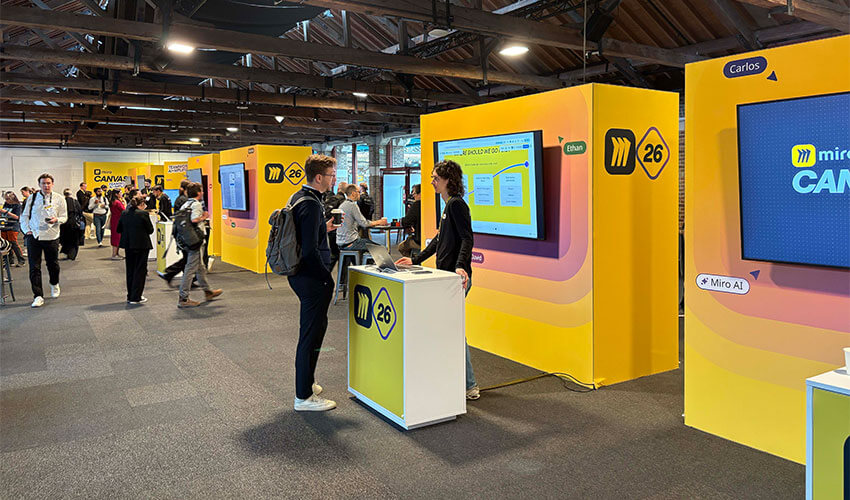
One feature that showcased this well was ENGAGE, which transformed Miro boards into interactive workshops open to anyone without a Miro account. Live polls, voting, Q&A sessions, and interactive activities were designed to foster more participation in discovery sessions, workshops, and client meetings.
One quote that resonated throughout the demonstrations was that "fun leads to deeper trust."
As more routine work becomes automated, the conversations, creativity, and relationships between people become even more valuable. Technology should strengthen collaboration rather than replace it.
Similarly, Talktrack offers a new way to preserve project context by allowing teams to record narrated walkthroughs of boards. Instead of simply handing over documents, organisations can capture the reasoning behind decisions, making onboarding, project handovers, and client communication significantly more effective.
What this means for businesses
Many of the themes discussed at Miro Canvas 26 reinforce conversations we're already having with organisations exploring AI adoption.
Whether that's automating repetitive processes, improving stakeholder workshops, validating ideas earlier through rapid prototyping, or creating a single source of truth for project information, the technology should ultimately help teams work together more effectively, not independently.
For businesses, the challenge is no longer whether to adopt AI. It's about how to integrate it in a way that strengthens collaboration rather than creating new silos.
Looking ahead
As we left Miro Canvas 26, one message stood out above everything else. The future of work isn't about using more AI. It's about using AI together.
While the platform demonstrations showcased impressive new capabilities, the most significant takeaway was the shift in thinking behind them. Success will come from helping people make better decisions, preserve context, and collaborate more effectively across every stage of a project.
Miro's vision suggests that collaborative work is becoming increasingly visual, AI-powered, and connected. Organisations that successfully embrace that shift won't simply work faster. They'll build stronger alignment, make better decisions, and create greater long-term value.
How we can help
At Blue Frontier, we help organisations embrace emerging technologies in ways that deliver real business value. Whether it's facilitating collaborative discovery workshops, designing intuitive digital experiences, or integrating AI into existing workflows, our multidisciplinary teams work closely with clients to solve complex challenges and improve the way they work.
By staying at the forefront of developments in AI, design, and digital collaboration, we help businesses adopt the right tools, processes, and strategies to drive innovation while keeping people, projects, and decision-making aligned.
If you're exploring how AI-powered collaboration could transform your organisation, or would like to discuss how tools like Miro can support your teams, get in touch with our experts today to see how we can help.